6 Strategic Financial Analysis
Associated slides: Lesson 4 — Strategic Asset Allocation
6.1 Introduction
Strategic financial analysis is a fundamental aspect of investment planning that involves evaluating the long-term financial environment and market conditions to inform investment decisions. This approach not only examines current financial data but also considers historical trends and future projections to develop a comprehensive understanding of potential investment opportunities and risks.
6.1.1 Definition and Role in Long-Term Investment Planning
Strategic financial analysis is defined as the process of analyzing financial statements, market trends, economic indicators, and other relevant data to forecast the future performance of investments. Its primary role in long-term investment planning is to ensure that investments are aligned with the client’s financial goals, risk tolerance, and investment horizon. This type of analysis provides a foundation for making informed decisions that can withstand market fluctuations and economic changes over time.
- Goal Alignment: By thoroughly understanding market dynamics and financial trends, strategic financial analysis helps align investment strategies with specific long-term goals such as retirement planning, wealth accumulation, or funding large future expenditures.
- Risk Assessment: It plays a crucial role in identifying potential risks associated with different investment options, enabling advisors to recommend strategies that appropriately balance risk and reward according to the client’s risk profile.
6.1.2 Comprehensive Market Analysis Informing Strategic Asset Allocation
Strategic asset allocation involves distributing investments across various asset classes (such as stocks, bonds, real estate, etc.) in a manner that is expected to maximize returns while minimizing risk, based on the client’s objectives and time horizon. Comprehensive market analysis is integral to this process:
Economic Indicators: Analysis includes reviewing economic indicators like GDP growth rates, unemployment rates, inflation, and central bank policies to predict economic cycles and their potential impact on various asset classes.
Market Trends: It also involves examining market trends such as interest rates, equity market performances, and sectoral shifts to understand the best opportunities for investment. For example, a trend towards lower interest rates might make bonds less attractive, shifting preference towards equities or alternative investments.
Historical Data: By analyzing historical performance data of various markets and asset classes, financial analysts can identify patterns and potential trends that could recur under similar economic conditions.
Geopolitical Factors: Considerations include geopolitical stability, trade policies, and international relations, as these can have significant impacts on market performance globally.
6.1.3 Conclusion
Strategic financial analysis is essential for crafting a robust investment strategy that can navigate the complexities of the financial markets and achieve long-term investment objectives. By employing comprehensive market analysis, investment advisors can develop strategic asset allocations that appropriately reflect each client’s investment goals, risk tolerance, and time horizon. This analytical approach ensures that portfolios are not only optimized for potential returns but are also robust enough to withstand economic and market fluctuations over time.
6.2 Market Outlook and Economic Variables
Understanding the market outlook involves analyzing a range of economic variables to anticipate future market conditions and their potential impact on investment returns. This analysis is crucial for strategic financial planning as it informs asset allocation decisions and helps in managing investment risks effectively.
6.2.1 Significance of Analyzing Economic Variables for Market Outlooks
Analyzing economic variables allows investors and financial analysts to gauge the health of the economy and predict market trends. These variables include indicators like inflation rates, interest rates, employment data, GDP growth, consumer spending, and business investment:
- Predicting Market Movements: Economic indicators can provide signals about the future direction of financial markets. For example, rising inflation may prompt central banks to increase interest rates, which typically leads to lower stock prices.
- Sector Impact Analysis: Certain economic variables can have specific impacts on different sectors of the market. For instance, high consumer spending might benefit the retail sector, while rising oil prices could boost the energy sector but harm transportation stocks.
- Global Economic Conditions: In today’s interconnected world, analyzing global economic variables is also crucial. Events like changes in foreign policy, international trade agreements, or economic sanctions can affect global market dynamics and influence domestic markets.
6.2.2 Methods for Forecasting Economic Variables and Assessing Their Impact on Investment Strategies
6.2.2.1 Quantitative Forecasting Methods
- Econometric Models: Use statistical methods to forecast economic data based on historical trends and relationships between variables. These models can predict future values of GDP, inflation, or interest rates.
- Time-Series Analysis: Involves analyzing sequences of data points to detect patterns that can be used for forecasting future values of economic indicators.
6.2.2.2 Qualitative Forecasting Methods
- Expert Opinion and Delphi Method: Gathering insights from industry experts or using the Delphi method to reach a consensus among a panel of experts on future economic conditions.
- Scenario Analysis: Developing different scenarios based on various sets of assumptions about how future events may unfold to understand potential impacts on the markets.
6.2.2.3 Integrating Forecasts into Investment Strategies
- Sensitivity Analysis: Assessing how sensitive an investment strategy is to changes in economic variables helps in understanding potential risks and returns under different economic conditions.
- Stress Testing: Applying extreme values of economic variables to investment models to test how well a strategy would perform under adverse conditions.
- Dynamic Asset Allocation: Adjusting asset allocation in response to changes in economic forecasts to manage risk and capitalize on predicted market movements.
6.2.3 Conclusion
The thorough analysis and forecasting of economic variables are integral to developing a robust market outlook. By understanding how these variables influence different aspects of the economy and financial markets, investment professionals can craft strategies that are well-positioned to achieve optimal returns while managing risks. This approach not only enhances the strategic asset allocation process but also supports the ongoing adaptation of investment strategies to meet the dynamic conditions of the global markets.
6.3 Assessing Long-term Risk/Return Profiles
Understanding the long-term risk/return profiles of different asset classes is essential for strategic financial analysis and effective portfolio management. This assessment helps investors make informed decisions by evaluating the potential rewards and risks associated with each asset class over an extended period.
6.3.1 Evaluate Historical Performance Data
- Data Collection: Start by gathering comprehensive historical performance data for various asset classes, including stocks, bonds, real estate, commodities, and alternatives. This data should cover several market cycles to provide a broad perspective on how different assets behave under various economic conditions.
- Risk/Return Analysis:
- Return Analysis: Calculate the average returns for each asset class over the historical period. This involves looking at annual growth rates, dividend yields, and capital gains.
- Risk Analysis: Assess the risk associated with each asset class by calculating the volatility of returns, typically measured by the standard deviation. Additionally, consider the worst-case drawdowns during market downturns to understand the potential loss scenarios.
- Comparative Analysis: Compare the risk/return profiles of different asset classes to identify which ones have historically provided the best risk-adjusted returns. This comparison can help in making strategic asset allocation decisions to balance portfolio risk and reward.
6.3.2 Utilizing Long-term Financial Trends to Project Future Performance
6.3.2.1 Trend Analysis
- Economic Trends: Analyze broader economic trends such as inflation trends, GDP growth rates, and interest rate movements that could influence asset performance. For example, periods of low interest rates have historically been favorable for stocks but less so for bonds.
- Market Cycles: Understand past market cycles to identify patterns that might repeat. This includes studying bull and bear market phases, sector rotations, and market responses to geopolitical events or policy changes.
6.3.2.2 Projection Techniques
- Extrapolation of Historical Trends: Use statistical methods to extrapolate past performance trends into the future, while being cautious about the assumption that historical patterns will continue unchanged.
- Scenario Planning: Develop scenarios based on different economic and market conditions to see how asset classes might perform under each scenario. This can include optimistic, pessimistic, and base-case scenarios.
6.3.2.3 Incorporating Current Market Dynamics
- Adjust projections based on current market conditions and recent economic data. For instance, if current equity valuations are significantly higher than historical averages, this might suggest lower future returns.
- Consider the impact of recent technological advancements, regulatory changes, or shifts in consumer behavior that might affect future performance.
6.3.3 Conclusion
Assessing the long-term risk/return profiles of various asset classes through historical data analysis and projection of future performance is crucial for crafting a resilient investment strategy. By understanding and utilizing long-term financial trends, investors can better position their portfolios to achieve desired outcomes while managing potential risks. This analytical process enhances the strategic financial planning necessary for achieving long-term investment goals.
6.4 Strategic Financial Analysis in Cesim Invest
Strategic financial analysis can be performed in the following app that is available under the link below: https://inno.uni.li/apps/invest/.
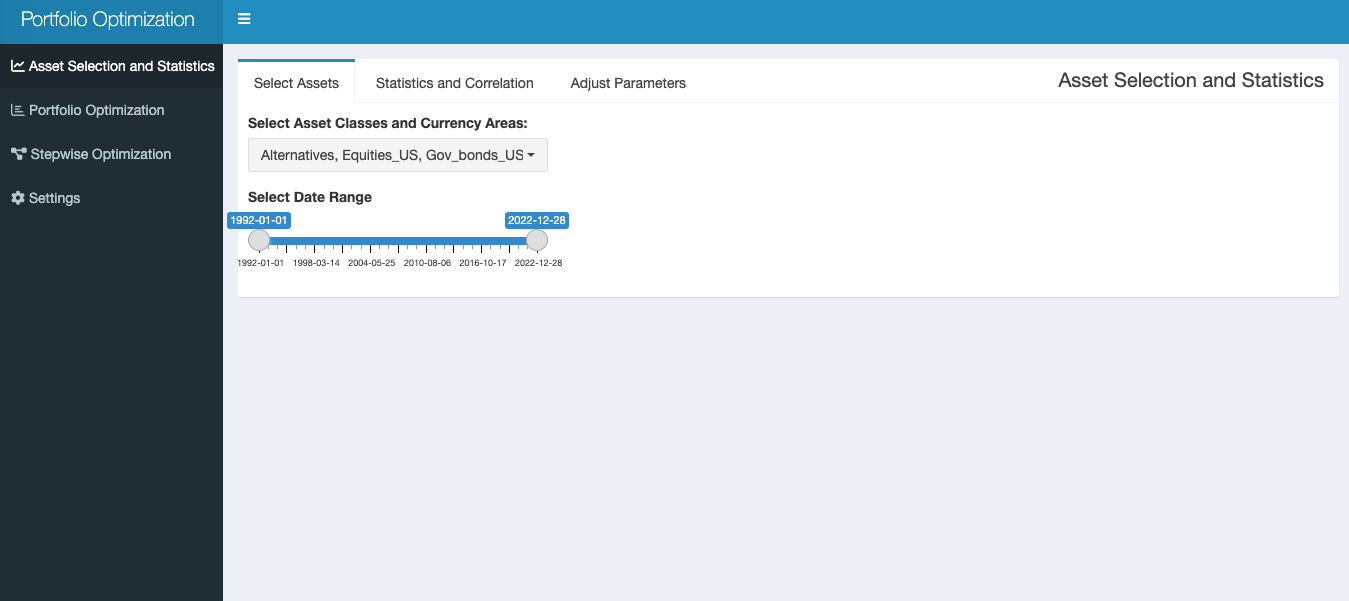
The initial Asset Selection and Statistics tab allows to select (or deselect) Asset Classes and Currency Areas as well as to choose the Date range to derive their long-term properties and covariances/correlations among them.
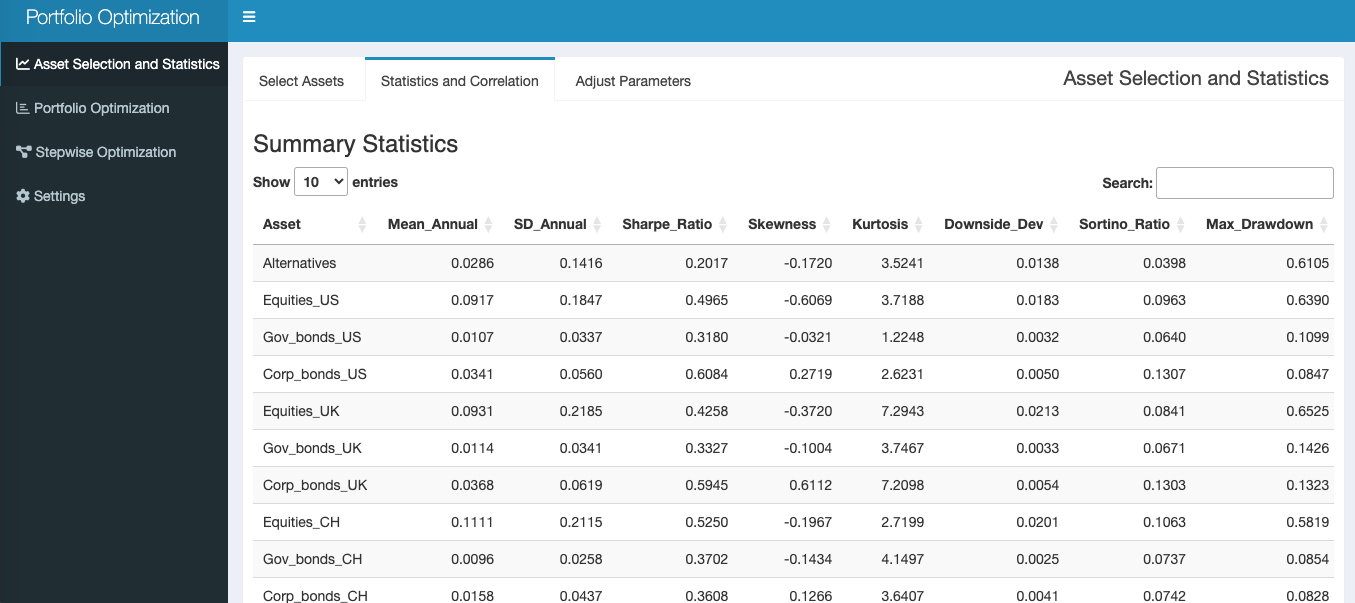
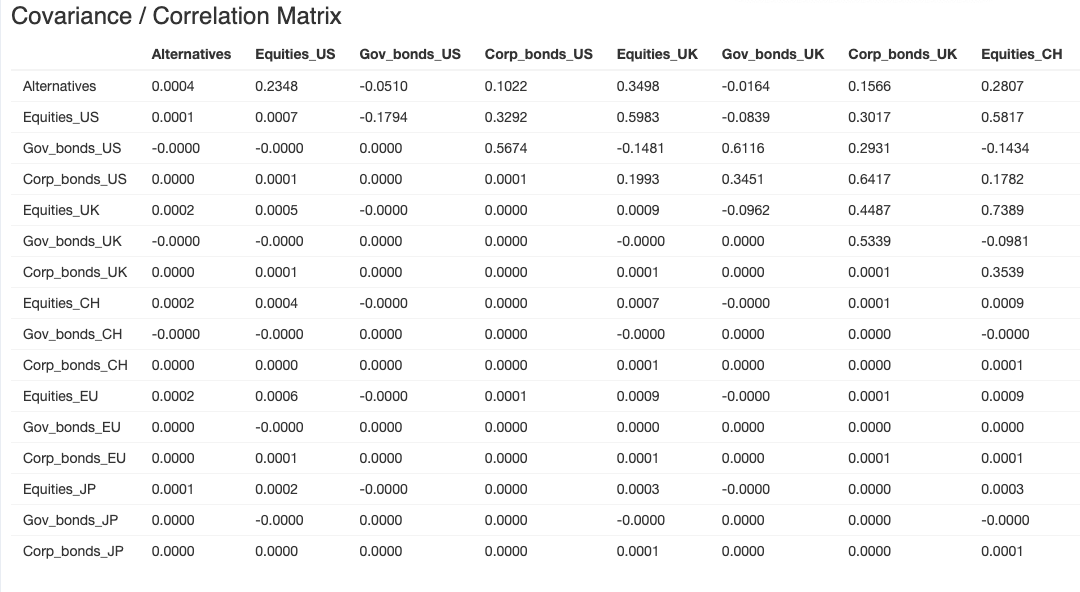
The statistics that are available include the annualised mean, annualised standard deviation, Sharpe ratio, skewness, kurtosis, downside deviation, Sortino ratio and maximum drawdown. Analysing them allows to determine the characteristics of each asset class/currency area in further detail and re-evaluate whether they belong to an investable universe of a given client type or not. Furthermore, these historical estimates of return, risk and correlation serve as an input for the portfolio optimisation in the next step.
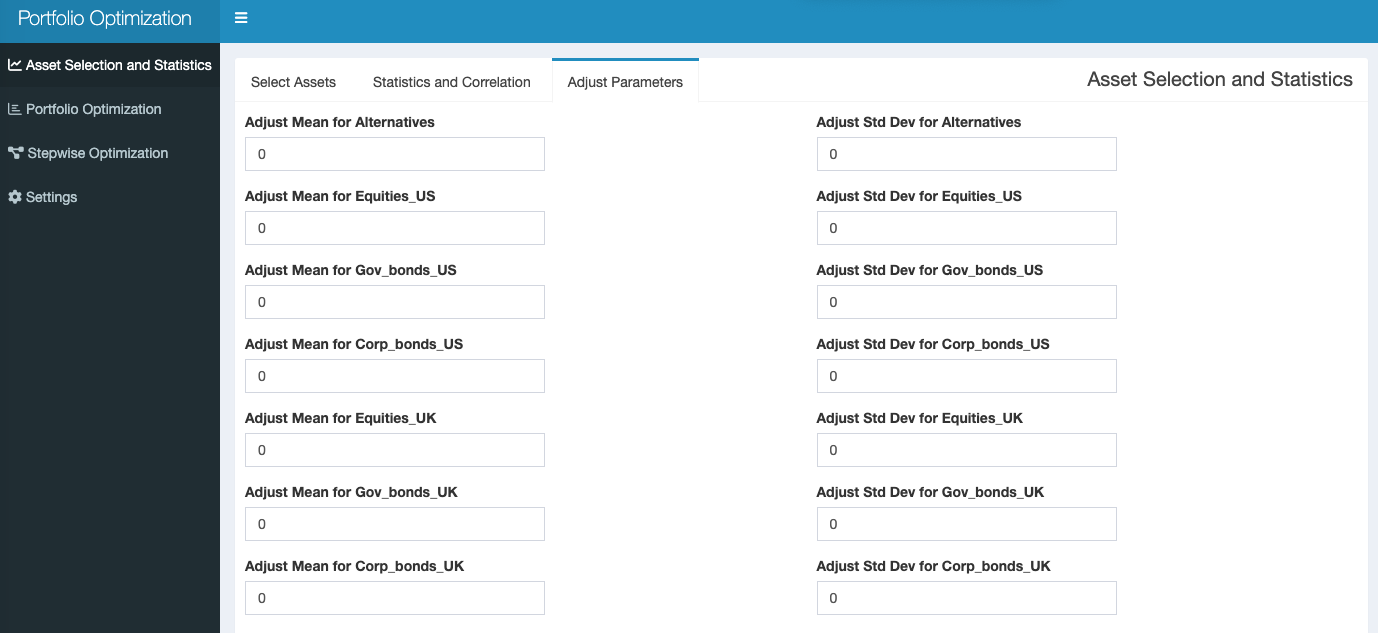
Prior to performing portfolio optimisation, there is also an opportunity to adjust some parameters, annualised mean and standard deviation, in particular, as shown below. This could be done based on market outlooks, for example.
6.5 Strategic Asset Allocation
Chapter 7 is entirely dedicated to deriving the Strategic Asset Allocation, here we only give a brief introduction. Strategic asset allocation is a key component of investment management that involves distributing investments across various asset classes to achieve the optimal balance between risk and return. This foundational strategy is designed to align with the investor’s long-term financial goals, risk tolerance, and investment horizon.
6.5.1 Foundations of Asset Allocation
6.5.1.1 Principles of Asset Allocation
- Risk and Return Trade-offs: Asset allocation is based on the principle that different asset classes offer different levels of expected return and risk. Investors must balance these elements to achieve their desired financial outcomes.
- Time Horizon: The allocation strategy heavily depends on the investor’s time horizon. Longer investment periods typically allow for greater exposure to riskier assets like stocks, which have higher volatility but potentially higher returns.
- Market Conditions: Strategic asset allocation also considers broader economic and market conditions, adjusting allocations based on cyclical factors and market forecasts.
6.5.1.2 Strategic Importance
- Achieving Financial Goals: Proper asset allocation is crucial for reaching financial targets, whether it’s accumulating wealth, generating income, or preserving capital.
- Long-term Focus: Unlike tactical asset allocation, which adjusts to short-term market conditions, strategic asset allocation is designed to remain relatively constant, adhering to a predetermined investment approach that supports long-term objectives.
6.5.2 Client-Specific Allocation
6.5.2.1 Tailoring to Client Needs
- Risk Tolerance: Asset allocation strategies are highly personalized based on the client’s comfort with risk. For instance, risk-averse clients may prefer a higher allocation to bonds rather than stocks.
- Return Objectives: The client’s financial goals directly influence how assets are allocated. For example, clients aiming for growth might have a higher proportion of equities, whereas those needing income might focus on bonds or dividend-paying stocks.
- Investment Horizon: The time frame until the client needs to access their invested capital significantly impacts asset allocation. Longer horizons can handle more risk, allowing for greater exposure to volatile asset classes.
6.5.3 Portfolio Diversification
6.5.3.1 Role in Risk Reduction
- Spreading Risk: Diversification involves spreading investments across various asset classes, sectors, geographies, and investment styles to mitigate risk. The goal is to construct a portfolio where gains in one area can offset losses in another, reducing the overall volatility.
- Correlation: Effective diversification requires understanding and utilizing the correlation between different asset classes. Assets that are less correlated with each other reduce portfolio risk more effectively.
6.5.3.2 Enhancing Returns
- Balanced Exposure: By diversifying across asset classes that perform differently under various economic conditions, investors can potentially enhance overall portfolio returns. Diversification allows for capturing gains in booming sectors while minimizing losses in others.
- Adaptive Diversification: Over time, the portfolio can be adjusted to tap into new opportunities and respond to changes in market dynamics, thereby potentially increasing returns without proportionately increasing risk.
6.5.4 Conclusion
Strategic asset allocation is a disciplined approach that forms the backbone of successful investment management. It ensures that investments are aligned with individual client profiles, including risk tolerance, return objectives, and time horizons, while diversification within the strategy helps manage risk and enhance returns over the long term. A well-formulated strategic asset allocation plan is essential for navigating complex market environments and achieving financial goals with confidence.
6.6 Sustainability and Investment
6.6.1 Integrating Sustainability into Strategic Financial Analysis
6.6.1.1 Considering ESG Factors
- Environmental Considerations: Analyze potential investments based on environmental criteria like carbon footprint, energy efficiency, and waste management. This involves assessing how companies mitigate environmental risks and capitalize on opportunities related to environmental sustainability.
- Social Considerations: Evaluate companies on their impact on social issues, including labor practices, community relations, and human rights. Social responsibility can influence consumer behavior, affect reputational risk, and impact financial performance.
- Governance Factors: Strong corporate governance can reduce risks and add value. This includes assessing management structures, employee relations, executive compensations, and shareholder rights.
6.6.1.2 ESG Integration in Asset Selection and Management
- Asset Selection: Incorporate ESG scores and ratings to select assets that align with sustainability values without compromising on financial returns.
- Portfolio Management: Manage the portfolio by continuously monitoring the ESG performance of holdings and adjusting the investment strategy to align with sustainability goals.
6.6.3 Analyzing Market and Economic Impacts of Climate Change and Sustainability Efforts
6.6.3.1 Sectoral Impacts
- Renewable Energy: Sectors such as solar and wind energy are benefiting from increased investment and policy support.
- Automotive and Transportation: Industries are transitioning towards electric vehicles and energy-efficient technologies, driven by both policy changes and consumer demand.
6.6.3.2 Economic Impacts
- Job Creation: The shift towards sustainable practices is creating jobs in new and emerging sectors, contributing positively to economic growth.
- Market Volatility: Transition risks and physical risks associated with climate change can cause market volatility. Strategic financial analysis must account for these risks across different asset classes and sectors.
6.6.4 Conclusion
Sustainability is transforming investment strategies globally. By integrating ESG factors into financial analysis, investors can mitigate risks and capture opportunities arising from the global shift towards sustainability. Understanding the financial implications of environmental policies like the EU Green Deal is crucial for forward-thinking investors aiming to adapt to and thrive in this changing landscape. As climate change continues to affect global markets and economies, the role of sustainability in investment strategies becomes not just strategic but essential for long-term success.
6.7 Tools and Techniques for Strategic Analysis
Effective strategic financial analysis is critical for making informed investment decisions. This analysis relies heavily on a robust set of tools that allow analysts to dissect financial statements, interpret market data, and evaluate economic indicators comprehensively. In this chapter, we will delve into the essential tools and techniques that equip financial analysts with the ability to uncover valuable insights from complex data, guiding both short-term trading and long-term investment strategies.
6.7.1 Tools for Analyzing Financial Statements, Market Data, and Economic Indicators
Financial statement analysis is foundational in understanding a company’s financial health and operational efficiency. Analysts employ various tools such as ratio analysis, which includes calculating profitability, liquidity, and leverage ratios to get a snapshot of the company’s financial condition. Trend analysis extends this by examining financial statement items over several periods, revealing underlying patterns that may not be apparent from a single year’s data. Common size statements, another crucial tool, normalize financial data, making it easier to compare companies of different sizes by expressing line items as percentages of a common figure.
When analyzing market data, financial analysts often turn to technical analysis software. This type of software helps them study past market data, primarily price and volume, to forecast future price movements in financial markets. Benchmarking tools are also widely used, enabling analysts to compare a security’s performance against broader market indices or sector-specific benchmarks, providing a relative performance measure that is crucial for assessing investment quality.
Moreover, understanding the broader economic environment is essential. Analysts use economic dashboards that consolidate data from key economic indicators such as GDP growth rates, inflation data, and employment statistics to paint a comprehensive picture of the economic landscape. Analyzing leading indicators, which signal future economic activity, allows analysts to anticipate market conditions before they manifest, providing a strategic edge in market timing.
6.7.2 Overview of Quantitative Methods
The strategic analysis also involves advanced quantitative methods that allow analysts to predict future market movements and assess risk more scientifically:
- Regression Analysis: This statistical method estimates the relationships among variables. It is used extensively to model the connections between a dependent variable and one or more independent variables. For example, regression can help determine how interest rates affect stock returns, helping analysts make more informed investment decisions.
- Monte Carlo Simulations: These are used to model the probability of different outcomes in a process that cannot easily be predicted due to the intervention of random variables. Monte Carlo simulations are particularly useful in the financial industry to assess risk and uncertainty in investment valuation, portfolio management, and financial planning.
- Scenario Planning: This involves constructing various plausible future scenarios to examine how changing economic, political, or environmental factors could affect markets and investments. Scenario planning aids in preparing for uncertainty by picturing different what-if scenarios and planning for possible risks and opportunities.
Imagine a financial analyst who wants to understand the relationship between the Federal Reserve’s interest rate changes and the stock market returns. The analyst collects monthly data over the past 10 years, including the effective federal funds rate and the S&P 500 index returns.
Using regression analysis, the analyst can model the dependency of stock returns (dependent variable) on interest rates (independent variable). The model might look like:
\[\text{Stock Returns} = \beta_0 + \beta_1 \times \text{Interest Rates} + \epsilon\]
where \(\beta_0\) is the intercept, \(\beta_1\) is the slope of the line, and \(\epsilon\) represents the error term.
Consider an investment manager assessing the risk of a portfolio over the next year. The manager models the future price of the portfolio based on historical volatility and expected returns. Monte Carlo simulations are used to run thousands of potential future scenarios to see how the portfolio might perform.
The simulations might show that, under current conditions, there is a 5% chance the portfolio could lose more than 20% of its value, helping the manager decide whether to rebalance the portfolio to reduce risk.
An energy company uses scenario planning to prepare for future changes in the regulatory environment affecting renewable energy. The company develops three scenarios: 1) increased regulations and incentives for renewables, 2) unchanged regulatory landscape, and 3) new taxes on renewable energy production.
For each scenario, they project revenue growth, cost implications, and investment needs, helping the company decide how much to invest in solar vs. wind technologies.
Scenario planning often involves qualitative assessments supported by quantitative models. Financial projections can be adjusted based on different assumptions about market growth rates, costs, and regulatory changes. This comprehensive planning enables the company to make flexible, informed decisions under various future conditions.
- Financial Statement Analysis Tools:
- Ratio Analysis: Involves calculating key financial ratios such as return on equity, debt-to-equity, and profit margins to assess a company’s financial health and operational efficiency.
- Trend Analysis: Examines changes in financial statement items over multiple periods to identify patterns or trends that may indicate future performance.
- Common Size Statements: Converts each line of financial statement data to a percentage of a base amount (e.g., total assets or sales), facilitating comparison across companies and industries regardless of size.
- Market Data Analysis Tools:
- Technical Analysis Software: Used to evaluate investment securities by analyzing statistics generated by market activity, such as past prices and volume.
- Benchmarking Tools: Compare the performance of securities against market indices or industry standards to gauge relative performance.
- Economic Indicator Analysis Tools:
- Economic Dashboards: Compile and display data from various economic indicators like GDP growth rates, inflation, employment figures, and consumer confidence indices to provide a comprehensive view of the economic landscape.
- Leading Indicators Analysis: Focuses on indicators that predict future economic activity, helping analysts anticipate market trends before they occur.
Overview of Quantitative Methods Summary
- Regression Analysis:
- Purpose and Application: Used to estimate relationships among variables. For example, it can help determine how changes in interest rates might affect stock prices.
- Tools: Software like R, Python, or specialized statistical packages such as SPSS or SAS, which allow for complex regression models and data analysis.
- Monte Carlo Simulations:
- Purpose and Application: Utilized to model the probability of different outcomes in processes that cannot easily be predicted due to the intervention of random variables. It is especially useful in the assessment of risk and uncertainty in forecasting models.
- Tools: Simulation software like Crystal Ball or Risk Solver, which provide platforms for running thousands of simulations to predict the likelihood of various investment outcomes under uncertainty.
- Scenario Planning:
- Purpose and Application: Involves creating specific narratives about how the future might unfold and how these changes could affect investments. This method is used to prepare for various possible futures by understanding how different factors might interact in complex ways.
- Tools: Strategic planning software or frameworks that facilitate the construction of detailed scenarios based on different assumptions about future market conditions and economic factors.
6.7.3 Conclusion
The tools and techniques discussed in this chapter are vital for the strategic financial analyst aiming to navigate today’s complex financial environments. They facilitate a deeper understanding of both the micro and macroeconomic factors that drive market dynamics, enhancing the analyst’s ability to devise robust investment strategies. By continuously advancing their skills in these areas, financial professionals can better serve their clients, offering insights that align with both current conditions and long-term investment goals.