3 Reading the market
Once you know the client, the next step is the market you invest in, because the strategic allocation is built on it. Asset classes differ: some are more volatile than others, some have a higher expected return, some move together and others in opposite directions.
3.1 Two sources of information, two uses
The game gives you two different things about the market, and they serve two different decisions.
- The history. The course dataset (loaded in the allocation app) holds the full history of the 21 positions: monthly total returns in US dollars, unhedged, and the US money-market rate. The strategic allocation of every client is defined on this history (Chapter 4). The game’s own Results page also lets you download the last five years of asset, factor and exchange-rate data as an Excel file; that is a subset of the same market.
- The Economic outlook. Each round, the analyst estimates the coming period: interest rates by maturity and currency, inflation and growth, factor premia, with an expected range around every estimate. This is forward-looking information and belongs to the tactical decision (Chapter 5). It is not an input to the strategic allocation.
Keep the two apart. The benchmark does not move with the outlook.
3.2 Station 1 of the app: statistics and correlations
Open the app (https://inno.uni.li/apps/invest/), station 1 · Strategic Asset Analysis. Keep the default selection (the 16 benchmark positions; the five money-market positions can be added for analysis) and the sample at the full history. The statistics table is annualised and in excess of the US money-market rate; the correlation matrix is of the same excess returns.
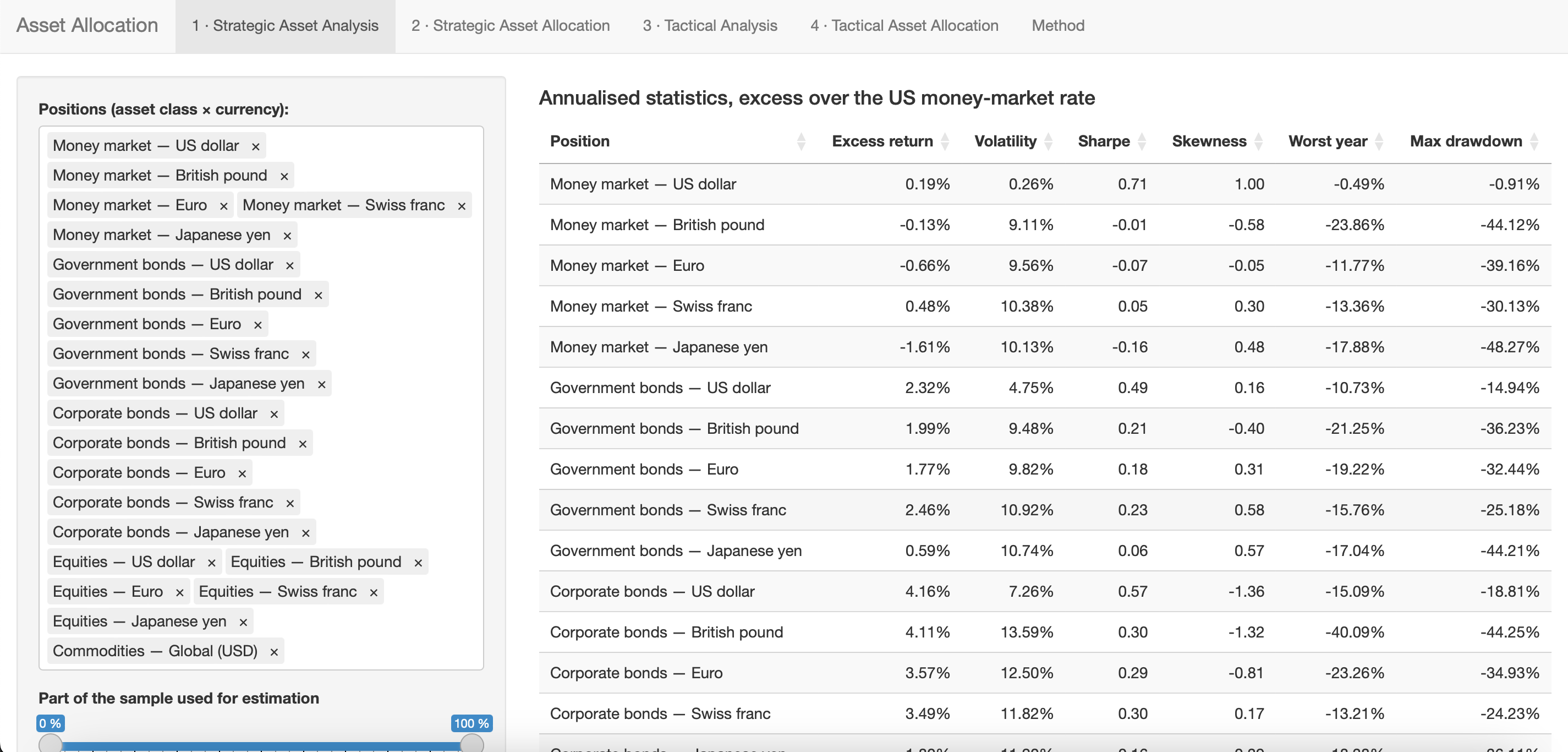
Three things to take from the table before you optimise anything.
The ranking by Sharpe ratio. Sort the table by the Sharpe column and read it top to bottom. The equity markets and the US bond positions sit at the top; the positions in a foreign currency other than equities sit at the bottom, several of them with a Sharpe ratio around zero or below. Ask of every position near the bottom what premium it is being paid.
What a foreign bond is in dollars. Compare the volatility of a country’s money-market position with that of its government bonds, and look at the correlation between the two. In dollars both are mostly the currency: the money market has the currency’s volatility on an excess return near zero, and the bond adds a few points of premium on top of the same currency risk. The game cannot hedge. Keep this in mind when you read the optimiser’s output in Chapter 4, and when you consider a tactical position in Chapter 6.
The correlation structure. The five equity markets move together, with correlations around 0.4 to 0.65 against the US; US government bonds are slightly negatively correlated with US equities. That negative correlation is what a defensive position is for.
Excess returns are measured over the US money-market rate, so the money market is the zero line of the table. The five money-market positions themselves are not in the benchmark: the game’s strategic grid has no cash row, and the client leaves cash to the manager. Add them in station 1 if you want to see them (in dollars, a foreign money-market position is the currency and nothing else); leave them out when you optimise the strategic allocation.
3.3 What not to do here
- Do not shift means or volatilities “to reflect your view”. The strategic benchmark is the sample; views enter in Chapter 5.
- Do not shorten the sample for the strategic allocation. The client’s benchmark is defined on the full history; a shorter window produces a different allocation and a worse score.
- Do not drop benchmark positions from the selection. Zero weights are the optimiser’s job, and the statistics of the full benchmark universe are what the attribution later refers to.
3.4 Deliverable of this step
Nothing to type into the game. What you should be able to say: which positions carry a portfolio and why; what a foreign bond or money-market position is, seen from the dollar; what the correlation between equities and US government bonds buys you.