UNDERSTANDING PENSIONS IN EUROPE (UNPIE)

Understanding Pensions in Europe

Erasmus+ Project 2016-2019: In this project we developed online courses to bring essential pension-finance knowledge to European citizens and higher-education students through accessible online courses and hands-on web applications.

An Erasmus+ initiative. Improving financial literacy with regard to pensions in Europe

  • • Two target groups: the general public and higher-education students.
  • • Modular learning from basics to advanced topics.
  • • Interactive apps to support understanding of complex topics.
Supported by Erasmus+

Project

Our goal is to transfer crucial knowledge about pension finance to the public and to students in related fields (finance, economics, business). Understanding pension systems requires elements of finance (discounting, annuities), insurance, demographics, and institutions. With demographics evolving and private savings becoming more important, informed individual decisions matter. We address this need through free, modular online courses and a suite of interactive applications that let users explore savings and retirement scenarios.

Project Events

Conference on Pension Finance and the Teaching of Pension Finance

University of Liechtenstein, August 29, 2019. Paper session with contributors from leading institutions; plenary by Prof. Michael Hanke and Dr. Sebastian Stöckl; keynote by Prof. Mogens Steffensen; presentation of the online courses developed in this project.

Program & Photos

Program

  • Session 1 — The Teaching of Pension Finance
  • 09:00–09:40 Mental Accounting, Fiscal Accounting, or Pensions as Piggy Banks? Pre-Retirement Pension Leakage — John Turner (Pension Policy Center, Washington, USA) — with Bruce W. Klein.
  • 09:40–10:20 Intergenerational Altruism and Transfers of Time and Money: A Life-cycle Perspective — Uta Bolt (UCL & IFS) — with Eric French, Jamie Hentall Maccuish, Cormac O’Dea.
  • 10:40–11:20 Bounded rationality and optimal pension design. Evidence from a life-cycle experiment — Wiebke Szymczak (Durham University, UK) — with Martin Angerer, Michael Hanke, Ekaterina Shakina.
  • 11:20–12:00 Saving Regret — Tabea Bucher-Koenen (Max Planck Institute for Social Law and Social Policy, MEA) — with Axel H. Börsch-Supan, Michael D. Hurd, Susann Rohwedder.
  • Session 2 — Pension Finance
  • 12:50–13:30 Transparency on Defined Benefit Obligations? Introducing Financial Theory to Financial Accounting — Ute Merbecks (Hochschule Rhein-Waal, Germany).
  • 13:30–14:10 Save or Pay-As-You-Go: The Effects of Ageing on Optimal Retirement Funding — Christian Hott (Helmut-Schmidt-Universität Hamburg, Germany).
  • 14:30–15:10 The Politics of Aging and Retirement: Evidence from Swiss Referenda — Piera Bello (USI, Switzerland), with Vincenzo Galasso (Bocconi; Dondena; IGIER; CEPR; CESifo).
  • Plenary Lectures (open to the public)
  • 15:45–16:25 Key Decisions to be Made by the Insured in Liechtenstein’s Pension System — Michael Hanke (University of Liechtenstein).
  • 16:25–17:05 Presentation of Online-Courses Developed in the E+ Project “Understanding Pensions in Europe” — Sebastian Stöckl (University of Liechtenstein).
  • Keynote
  • 17:05–18:00 Epiphanies in Pension Design and Valuation — Mogens Steffensen (University of Copenhagen).
Download program (PDF)

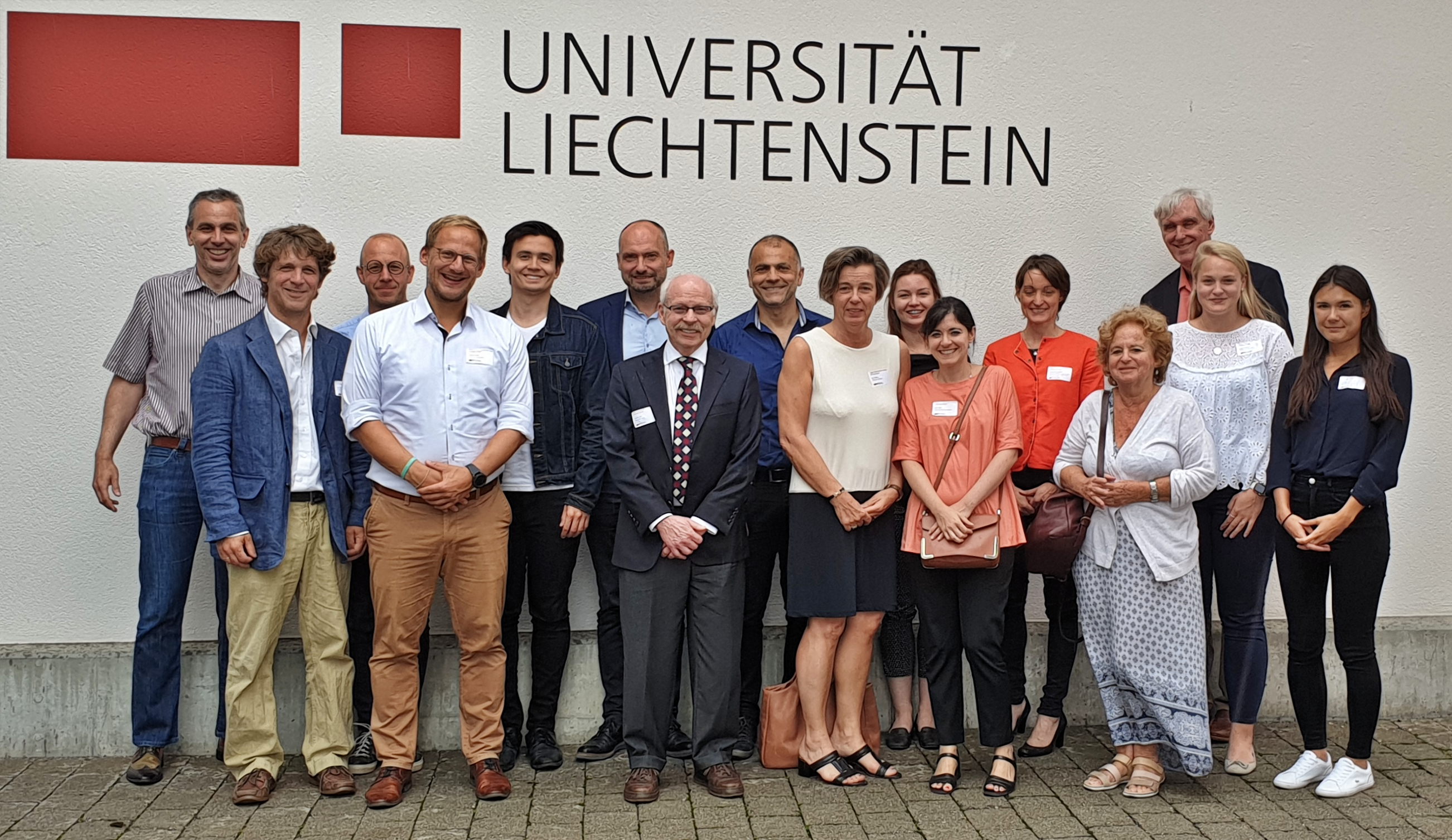
Group photo

UNPIE Conference 2019 — Group photo
UNPIE Conference, University of Liechtenstein, Aug 29, 2019

Final Project Meeting in Vaduz

Vaduz, August 28, 2019. Presentation of the final outputs (three online courses on courseware.uni.li), discussion of dissemination and next steps.

Photos

Agenda

  • Outcomes review, platform demos, overall project success

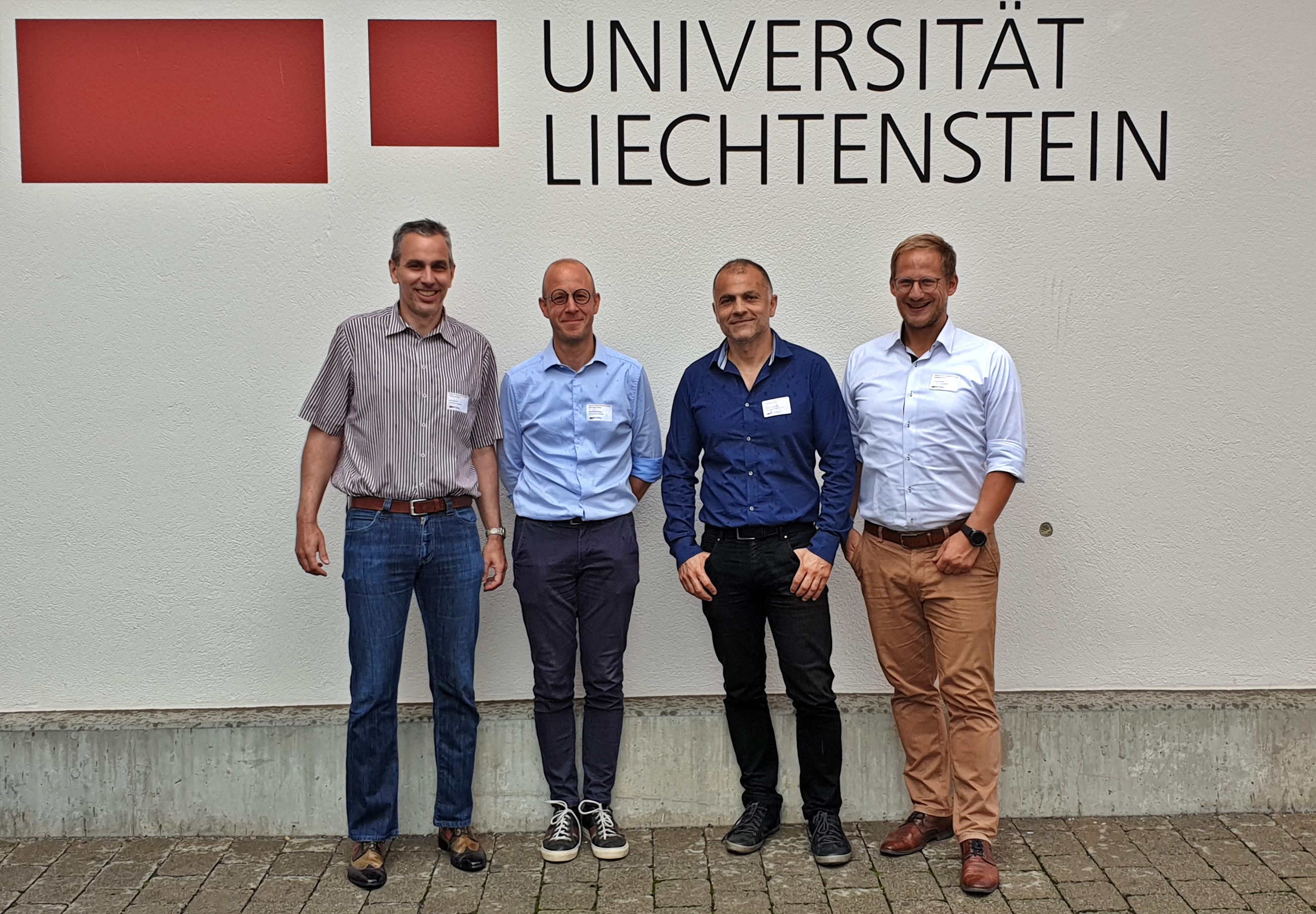
Group photo

UNPIE Final Meeting — Group photo
UNPIE Final project Meeting, University of Liechtenstein, Aug 29, 2019

Project Team & Partners

Free University of Bozen–Bolzano

Free University of Bozen–Bolzano

Co-development of online courses; pedagogical design and assessment.

Show team
Keylane / Schantz

Keylane (Schantz)

Industry expertise and pension-planning software; integration with course modules.

Show team
Kourosh Rasmussen

Kourosh Rasmussen

Project Member

Outcomes

Online Courses (MOOCs)

Two modular MOOCs: (1) an accessible course for citizens (German and English) and (2) an advanced course for students.
Status: content consolidation in progress; one course is currently piloted on Coursera to test delivery and engagement.

Interactive Web Applications

A suite of webR-powered tools that let users simulate savings paths, pensions, longevity effects, and ruin probabilities. These apps are embedded in the courses and freely accessible.

Apps

Introductory Apps (click to expand)
App 1: Future value of single savings payment — screenshot

App 1: Future value of single savings payment

FV of a single savings payment.

App 2: Future value (nominal and real) of single savings payment — screenshot

App 2: Future value (nominal and real) of single savings payment

FV of one payment, with nominal vs real comparison.

App 3: Future value of constant yearly savings payments — screenshot

App 3: Future value of constant yearly savings payments

FV of constant annual savings.

App 4: Future value (nominal and real) of constant (nominal) yearly savings payments — screenshot

App 4: Future value (nominal and real) of constant (nominal) yearly savings payments

FV of nominal yearly savings in nominal vs real terms.

App 5: Future value (nominal and real) of constant (real) yearly savings payments — screenshot

App 5: Future value (nominal and real) of constant (real) yearly savings payments

FV of real yearly savings in nominal vs real terms.

App 6: Required wealth to finance constant (nominal) yearly spending — screenshot

App 6: Required wealth to finance constant (nominal) yearly spending

Wealth needed for constant nominal spending.

App 7: Required wealth to finance constant (nominal/real) yearly spending — screenshot

App 7: Required wealth to finance constant (nominal/real) yearly spending

Wealth needed for constant spending (nominal or real).

App 8: Real yearly spending financed by given (real) yearly savings — screenshot

App 8: Real yearly spending financed by given (real) yearly savings

Real spending supported by given real savings.

App 9: Yearly savings required to finance given yearly spending (both in real terms) — screenshot

App 9: Yearly savings required to finance given yearly spending (both in real terms)

Savings needed to fund target real spending.

Apps Including Risk (click to expand)
App 10: Real yearly pension resulting from constant (real) yearly savings — screenshot

App 10: Real yearly pension resulting from constant (real) yearly savings

Stochastic real pension from constant real savings.

App 11: Real yearly savings required to reach minimum desired (real) yearly pension with probability p — screenshot

App 11: Real yearly savings required to reach minimum desired (real) yearly pension with probability p

Savings required to hit a target pension with probability p.

App 12: Years to ruin when spending yearly from given retirement savings — screenshot

App 12: Years to ruin when spending yearly from given retirement savings

Years to portfolio ruin under yearly spending.

App 13: Maximum periodic spending possible to exceed specified minimum years to ruin with probability p — screenshot

App 13: Maximum periodic spending possible to exceed specified minimum years to ruin with probability p

Max spending s.t. years-to-ruin ≥ threshold with probability p.

Longevity Risk & Mortality (click to expand)
App 7m: Pension fund’s view — Required wealth to finance constant (nominal/real) pension payments — screenshot

App 7m: Pension fund’s view — Required wealth to finance constant (nominal/real) pension payments

Required wealth for lifelong pensions under mortality.

App 8m: Real pension payments that can be financed by given (real) savings — screenshot

App 8m: Real pension payments that can be financed by given (real) savings

Real pension payments supported by given real savings.

App 9m: Savings required to finance given life-long continuous spending (both in real terms) — screenshot

App 9m: Savings required to finance given life-long continuous spending (both in real terms)

Savings needed for lifelong continuous real spending.

App 14: "Fair" conversion rate for given mortality and constant expected (or average) investment returns — screenshot

App 14: "Fair" conversion rate for given mortality and constant expected (or average) investment returns

Approximate fair annuity conversion rate given mortality & returns.

App 15: Approximate probability of retirement ruin for given spending rate, wealth & log-normal real returns — screenshot

App 15: Approximate probability of retirement ruin for given spending rate, wealth & log-normal real returns

Approximate ruin probability under log-normal returns.

App 16: Moments and conditional survival probabilities for the Gompertz–Makeham distribution — screenshot

App 16: Moments and conditional survival probabilities for the Gompertz–Makeham distribution

Moments & survival probabilities under Gompertz–Makeham.

Overview: Explore and Filter all Apps

Contact

Liechtenstein Business School, University of Liechtenstein
Fürst-Franz-Josef-Strasse, 9490 Vaduz, Liechtenstein
Project Director: Prof. Dr. Michael Hanke  •  Project Coordinator: Prof. Dr. Sebastian Stöckl