Elections

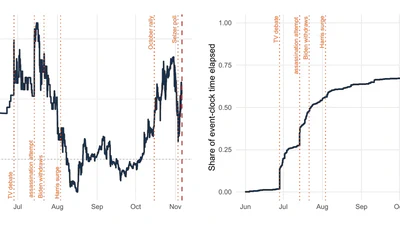
The Event Clock: Identifying Physical Information from State Prices

How much of the price variation ahead of a scheduled event reflects genuine learning rather than valuation shocks? Three prediction-market venues identify the learning-spanned …

michael-hanke
•
The Milei Question, or: How Liberal Are Right-Wing Populist Parties? A Measurement Approach Using Large Language Models featured image

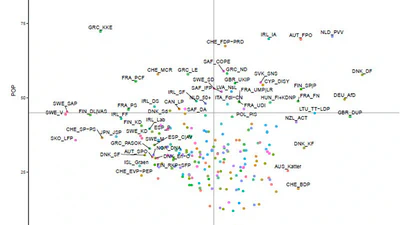
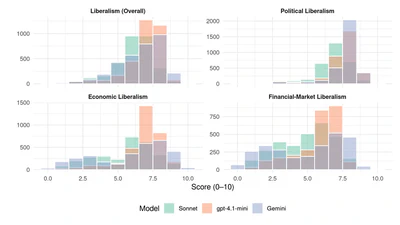
The Milei Question, or: How Liberal Are Right-Wing Populist Parties? A Measurement Approach Using Large Language Models

Large language models are used to score populist rhetoric and four dimensions of liberalism across party manifestos, showing that right-wing populist anti-liberalism is largely …

Martin Rode
•

Populism and Financial Markets

Replication and extension of Stöckl & Rode (2021) examining how populist electoral success affects option-implied risk assessments. Forthcoming in the Edward Elgar Handbook on …

dejan-zafirev
•
Political Finance featured image

Political Finance

Using market prices to measure how political events and populist electoral shifts are priced into equities, volatility, and cross-country asset returns.

Learning Before Scheduled Events: Prediction Markets, State Prices, and Option Valuation featured image

Learning Before Scheduled Events: Prediction Markets, State Prices, and Option Valuation

Options spanning a scheduled event are priced from observed event-clock inputs, with sequential overidentification restrictions tested on the Brexit referendum and on 2024 U.S. …

michael-hanke
•
The Price of Populism - Financial Market Outcomes of Populist Electoral Success featured image

The Price of Populism - Financial Market Outcomes of Populist Electoral Success

We examine the effect of populism on financial markets around national elections. We find that the electoral success of populist parties has a direct impact on volatility in major …

Sebastian Stöckl
•