Learning Before Scheduled Events: Prediction Markets, State Prices, and Option Valuation

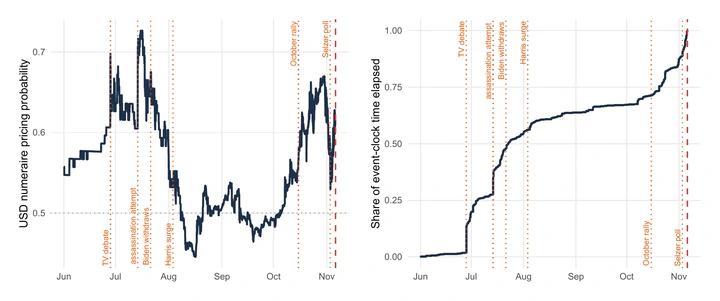 The 2024 U.S. presidential election on Polymarket. Left: the traded event probability in calendar time. Right: the share of event-clock (information) time elapsed. Information does not arrive evenly — it concentrates in bursts around the TV debate, the assassination attempt, Biden’s withdrawal, and the late-October news flow.
Abstract
Investors learn about the outcome of a scheduled event before it resolves, and that learning is observable in traded event probabilities. Taking event-clock inputs as observed market objects, this paper prices options written across a scheduled event and derives sequential overidentification restrictions that the resulting valuations must satisfy. The empirical analysis pairs a conventional foreign-exchange benchmark around the Brexit referendum with the 2024 U.S. presidential election, where exchange-traded options on an election-exposed stock allow conditional distributions to be recovered on each side of the outcome. Held-out pre-election option wings reject an independent, fixed-law benchmark across a broad range of clock uncertainty, and disagreement across venues is shown to be economically informative rather than noise.
Type
Publication
Working Paper (University of Liechtenstein & Free University of Bozen-Bolzano)
Note
This paper supersedes the earlier working paper Stochastic Event-Outcome Probabilities and the Pricing of Scheduled Event Risk (Hanke, Schadner, Stöckl & Weissensteiner), which circulated before that under the title Event Risk Premia and Non-Convex Volatility Smiles.
The structural learning and recovery theory has since been split off into a separate paper, The Event Clock: Identifying Physical Information from State Prices.
The estimators, closed-form calculators, and event-probability datasets used in this paper are available in the eventclock R package.